


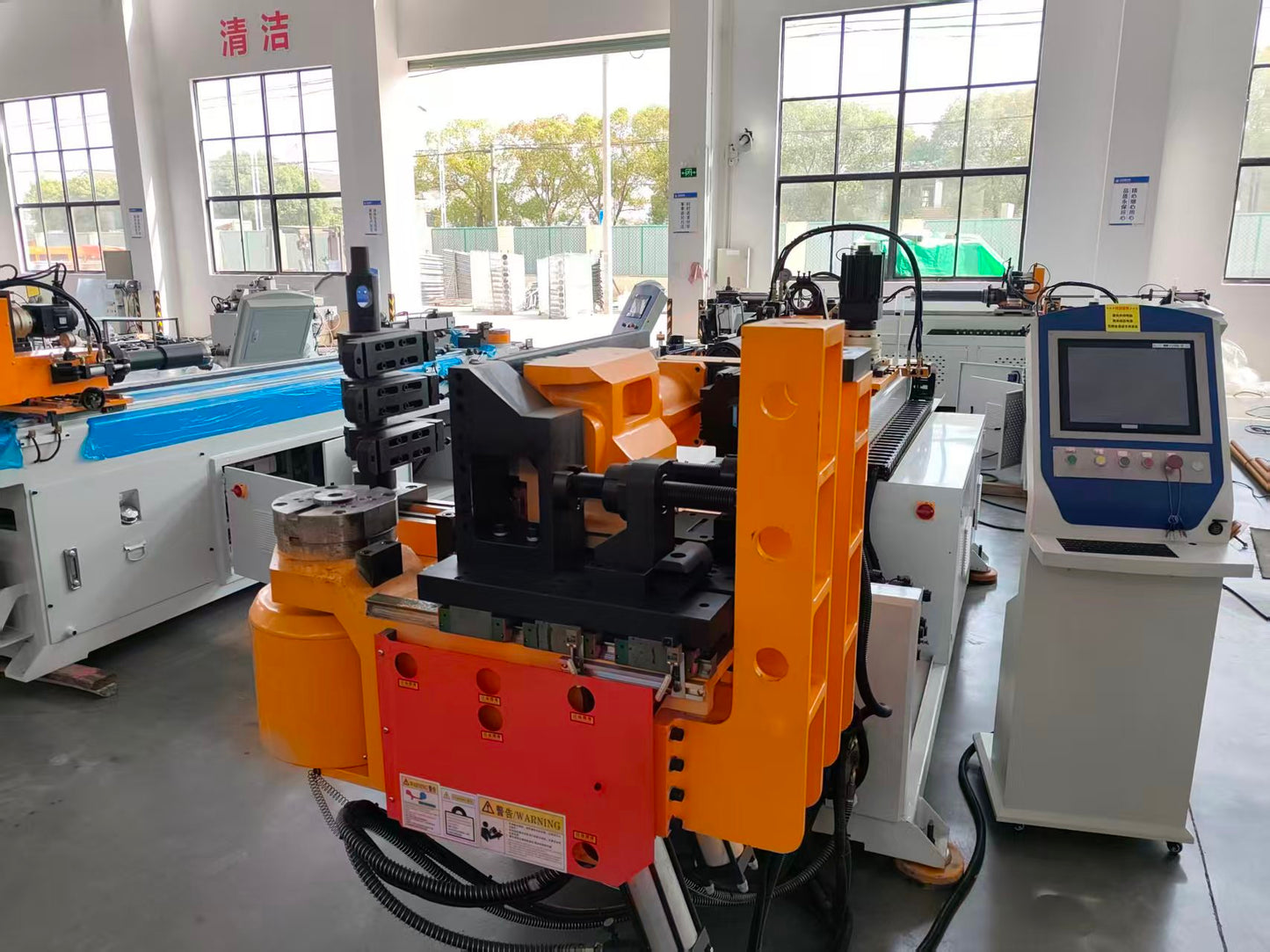
5-axis 3-layer mold CNC pipe bending machine, model 89
5-axis 3-layer mold CNC pipe bending machine, model 89
I. Equipment Overview
This equipment is a high-precision, high-performance 5-axis linkage 3-layer membrane (or multi-layer anti-wrinkle mold) all-electric servo CNC pipe bending machine, usually referred to as "Model 89" to indicate its specific design series (such as pipe diameter capacity, structural form, etc.). It integrates pure electric servo drive technology, a multi-layer membrane anti-wrinkle system, an advanced CNC control system, and real-time 3D detection feedback, specifically designed for the cold bending of complex spatial curve metal pipes (such as stainless steel, carbon steel, aluminum, and copper pipes). It is particularly suitable for industries with extremely high requirements for precision, surface quality, and production efficiency, such as automotive exhaust systems, chassis oil pipes, air conditioning refrigeration pipes, aerospace pipes, fitness equipment, and high-end furniture.
II. Core Concepts of "5-Axis 3-Layer Membrane"
5-Axis: Refers to the five motion axes that can be CNC linked during the pipe bending process.
B-axis (Bending Axis): The spindle rotates, driving the bending mold to rotate for bending.
Y-axis (Feed Axis/Propulsion Axis): Drives the pipe forward/backward in a straight line, determining the length of the straight segment between bends.
C-axis (Clamping Axis): Drives the clamping die to open and close, securing the tube during bending.
P-axis (Pressure Die/Push Axis): Drives the pressure die to assist in feeding, preventing the tube from sliding backward during bending and compensating for material flow.
T-axis (Anti-wrinkle Die Rotation Axis): Drives the anti-wrinkle die (multi-layer film) assembly to rotate, always aligned with the bending tangent, providing uniform support to the inner wall of the tube.
(Note: Some models may define the "P-axis" for other functions, but the core is these 5 motion units.)
3-Layer Film (Multi-Layer Anti-Wrinkle Die): This is the core technology of this model for handling thin-walled tubes and tubes with small bending radii without producing wrinkles.
Structure: Consists of a set (usually 3 or more) of independent anti-wrinkle die sheets (commonly known as "films") with special profiles, stacked together and mounted in a rotatable bracket.
Function: During bending, the multi-layered diaphragm adapts to the deformation curve of the tube's inner wall, providing continuous and uniform support from multiple points on the inner wall. This effectively disperses compressive stress on the inner side of the bend, thus completely preventing wrinkling of the inner wall and significantly improving wall thickness reduction and ellipticity.
Advantages: Compared to traditional single anti-wrinkle dies or mandrels, it achieves a smaller relative bending radius (R/D) and significantly improves the surface quality and dimensional accuracy of the bent tube.
III. Core Mechanical Structure Components
1. Machine Body and Bed
Structure: The bed is welded from high-rigidity cast iron or heavy-duty steel, undergoing stress relief and precision machining. It possesses extremely strong torsional and vibration resistance, providing a stable reference for all motion axes.
Layout: Modular design, integrating the feeding system, bending head, and control system into a compact structure.
2. Bending Head Assembly (Core Unit)
Bending Drive: Employs a high-torque, high-response AC servo motor, directly driving the spindle (B-axis) through a high-precision reducer, achieving backlash-free precise angle control. Clamping Mechanism: Driven by an independent servo motor (C-axis), it generates a large locking force through a toggle or lead screw mechanism, ensuring no relative slippage between the tube and the bending die during bending.
Die Assembly: Includes the bending die (main spindle die), clamping die, and pressure die (booster block). All are precision-ground from high-strength alloy steel, with specially hardened surfaces for long wear resistance and durability.
3. Feeding System
Y-axis: Typically uses a large-diameter precision ball screw and high-rigidity linear guide, driven by a servo motor, to achieve long-distance, high-speed, and high-precision positioning of the tube.
P-axis (Booster): Works in conjunction with the Y-axis, providing thrust at the moment of bending to compensate for material elongation and ensure the accuracy of the straight segment length.
4. Multi-layer Film Anti-wrinkle System
Anti-wrinkle Die Assembly: Composed of an anti-wrinkle die support, multi-layer diaphragms, an adjustment mechanism, and a T-axis rotary drive unit.
Working Principle: The T-axis ensures that the anti-wrinkle die inlet direction is always aligned with the tube bending tangent. Multi-layered diaphragms, pre-compressed by springs or hydraulic pressure, slide along the inner wall of the tube during bending and adapt to its deformation shape, providing dynamic and continuous internal support.
5. Control and Measurement Systems
CNC Control System: Employs a dedicated tube bending CNC system (such as Cybelec, ESA, FANUC, etc.) with a powerful human-machine interface.
Functions: Supports 3D graphical programming, importing 3D models (such as DXF/IGES), automatic calculation of process parameters (such as springback, elongation), multi-program storage, and online diagnostics.
Real-time Measurement and Feedback System (Optional/High-end Standard): Integrates a laser measuring head to scan the 3D shape of the tube in real time during bending or after each bend, compare it with the theoretical model, and automatically correct subsequent bending parameters to ensure 100% qualification of the first piece and batch pieces.
IV. Typical Technical Parameters (Taking Model 89 as an example)
Bending Capacity (Pipe Diameter): Typically φ8mm - φ89mm (the name "Model 89" often derives from the maximum processed pipe diameter), depending on the pipe material and wall thickness.
Maximum Wall Thickness: 2.0mm - 4.0mm, depending on the material.
Minimum Relative Bending Radius (R/D): 1.0D - 1.5D or even smaller extreme bending is achievable thanks to 3-layer membrane technology (depending on the material).
Bending Speed: Up to 100°/second or more.
Bending Accuracy:
Angle Repeatability: ±0.1°
Straight Segment Length Accuracy: ±0.1 mm
Three-Dimensional Spatial Position Accuracy: ±0.2 mm
Spindle Drive: All-electric servo.
Control System: Dedicated CNC system with multi-axis linkage.
V. Core Advantages and Applicable Fields
Core Advantages:
Wrinkle-Free High Quality: 3-layer membrane technology guarantees high-quality thin-walled pipe bending, eliminating the need for subsequent shaping processes.
Ultra-high precision: All-electric servo drive + closed-loop control, combined with real-time measurement, achieves "one-time forming, no trial bending required."
High efficiency and flexibility: 5-axis linkage can easily complete complex 3D spatial tube shapes, with rapid mold change and programming, suitable for small-batch, multi-variety production.
Energy-saving and environmentally friendly: Pure electric drive, no hydraulic system, low energy consumption, low noise, clean and leak-free.
Intelligent: Equipped with automatic compensation, database management, and networking (Industry 4.0) capabilities.
Typical application areas:
Automotive industry: Engine oil lines, fuel lines, brake lines, exhaust system manifolds and muffler lines.
Air conditioning and refrigeration: Condenser and evaporator coils, refrigerator refrigerant lines.
Aerospace: Hydraulic system lines, oxygen supply lines.
Fitness equipment: Elliptical trainer, treadmill frame.
Furniture and decoration: Stainless steel chair frames, armrests, guardrails.
Summary: The 5-axis 3-layer film CNC tube bending machine (Model 89) represents the pinnacle of modern cold bending tube technology. It combines precise mechanical design, advanced motion control, and unique anti-wrinkle technology, making it the ultimate solution for meeting the manufacturing needs of high-end, complex, and high-quality pipe fittings.
compartir


Brindamos a los clientes los siguientes servicios
PRINCIPAL SERVICIO POSTVENTA:
Proporcione detalles en cada una de las filas plegables para dar a sus clientes la información que necesitan para elegir el mejor producto.
Cambie el título y el icono de cada fila para adaptarlos a su marca.
Instalación y depuración y formación
Los técnicos pueden ser enviados a la fábrica para recibir capacitación (sin cargo de servicio por primera vez) Los clientes solo necesitan proporcionar alojamiento a los ingenieros.
Capacitación gratuita dentro de la garantía, pero los clientes deben hacerse cargo del costo del alojamiento, los boletos aéreos y la tarifa de la visa.
Servicio en línea 24H
Todos nuestros equipos láser cuentan con 24 meses de garantía. Nosotros, TWCNC, ofrecemos mantenimiento gratuito o servicio de reemplazo si algo está mal con el equipo bajo garantía. Si está fuera de garantía, TWCNC enviará ingenieros a su fábrica lo antes posible y solo cobrar el costo de las piezas.
Diagnóstico remoto
TWCNC puede verificar el estado de funcionamiento de la cortadora láser del cliente a través de nuestro sistema de mantenimiento remoto.Nuestros técnicos pueden realizar la resolución de problemas a través del acceso remoto en lugar del diagnóstico y mantenimiento en el sitio, ahorrándole mucho tiempo.
Suscríbete a nuestros correos
Sé el primero en enterarte de nuevas colecciones y ofertas exclusivas.